
Minister of Manpower Lin San-quei (林三貴) said on Tuesday (17/3) that migrant workers traveling outside Taiwan will be temporarily prohibited from re-entering the country until the COVID-19 coronavirus pandemic subsides, Friday (20/3/2020).
Reporting from Focus Taiwan, the temporary entry ban is part of the government’s latest preventive measures against the spread of COVID-19 in its territory announced at a press conference of the Taiwan Epidemic Command Center (CECC).
According to the Ministry of Manpower (MOL) starting Thursday (19/3), migrant workers in Taiwan who wish to travel abroad will no longer be granted re-entry permits by the National Immigration Agency (NIA). The ban will be lifted once the COVID-19 epidemic subsides, the MOL said in a statement.
Migrant workers who are currently overseas but have a re-entry permit will be allowed to return, but they must self-quarantine for 14 days if they are from a country that is on a CECC Level 3 travel warning.
To date, the CECC has issued a Level 3 travel warning for 99 countries and regions, including Indonesia, the Philippines, Vietnam and Thailand.
The MOL spokesperson said that for migrant workers who must travel to their home countries during this COVID-19 outbreak, their employers will be able to apply for re-entry once the epidemic subsides.
“In the case of migrant workers who have booked a trip to their home country, MOL will compensate them for the rescheduling or cancellation fees incurred,” said MOL spokesman Lin, quoted from Focus Taiwan.
In addition to the temporary entry ban, Lin also announced other measures regarding migrant workers in Taiwan, which he said were all aimed at preventing the spread of COVID-19.
For example, the employer will have the option of being able to extend the employment contract by three months, if the migrant worker will reach the legal limit of staying in Taiwan within the next three months.
Currently, the maximum prison term for a residence permit violation is 14 years for domestic workers, and 12 years for all other categories of migrant workers.
Lin said the MOL also encourages employers to renew existing migrant worker contracts in Taiwan, instead of bringing in new workers from agreed-upon countries.
He said if migrant workers are traveling from countries under a Level 3 travel warning, employers must submit a form in advance to the labor ministry, detailing where workers will be quarantined for the required 14 days and how they will be transported there.
According to Lin, if employers or employers fail to provide this information to the labor ministry, it will result in a ban on the entry of their workers to Taiwan.
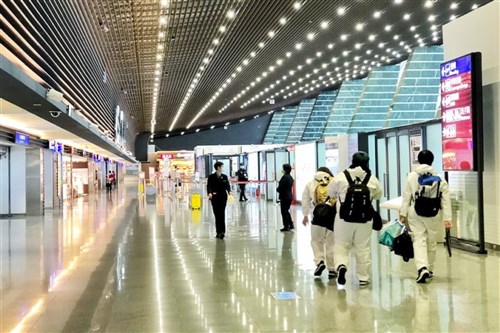
The labor ministry has also mandated that migrant workers will be allowed to enter Taiwan only at Taoyuan International Airport or Kaohsiung International Airport, where they must report to the MOL Foreign Workers Service Station and will be provided with six surgical masks each.
According to MOL data, an average of 624 migrant workers enter Taiwan every day, 73 percent of whom are new workers.
Meanwhile, Deputy Minister of Labor Liu Shih-hao (劉士豪) said last Tuesday (17/3) that employers in Taiwan have the right to prohibit their workers from leaving the country during the outbreak of the COVID-19 pandemic.
According to Liu, under their employment contract, workers and employers have obligations to each other, which can be classified as primary and secondary obligations. For employers, their primary obligation to workers is to pay their wages, while their secondary obligations include ensuring workplace safety and preventing accidents.
The primary obligation of employees is to provide labour, while their secondary obligation includes not engaging in behavior that could harm their employer’s operations. Travel bans on employees could be imposed under secondary liability provisions on both sides, Liu said.
Mandatory quarantine also applies to foreign tourists arriving in Taiwan from 99 countries and regions, including all of Asia and Europe, now they are required to self-quarantine for 14 days, because according to Liu, this is a secondary obligation that all arrivals must pay attention to.